Automatic Defect Classification: How It Works & Why It Outperforms AOI
Averroes
Apr 10, 2026
If your inspection line is catching defects but drowning in false positives – or classifying them in a separate step – you’re paying a yield tax you don’t have to.
Automatic defect classification collapses detection and classification into one real-time AI step, on your existing equipment.
Key Notes
AI defect classification cuts false positives from 35% to under 3% vs AOI.
Detection and classification happen in one pass – no separate review step needed.
Models train on just 20–40 images per class and improve continuously over time.
ADC deploys on existing inspection equipment across most manufacturing industries.
What Is Automatic Defect Classification?
Automatic defect classification (ADC) is an AI-powered inspection method that detects and classifies manufacturing defects simultaneously – in real time, from a single image pass.
ADC does both in one step using deep learning and computer vision, on your existing AOI, KLA, or Onto equipment.
No new hardware. No process changes.
ADC vs AOI:
Traditional AOI tells you that something looks wrong.
ADC tells you what it is, how severe, and how confident the model is – without a separate review step.
The Problem ADC Solves: False Positives At Scale
Rule-based AOI systems average 30–50% false positive rates.
Your QA team reinspects parts that are fine, instead of acting on real yield problems. And when AOI does catch a real defect, it can’t classify it – that’s a separate step, a separate queue, a separate delay.
Industry benchmark: Rule-based AOI averages 35% false positives. AI-powered ADC consistently delivers below 3% – without reducing sensitivity to real defects.
ADC closes both gaps: fewer false alarms, classification in the same pass, confidence-scored output your team can act on immediately.
How Automated Defect Classification Works
Five steps from image capture to actionable output – all in a single pipeline:
1. Image Acquisition
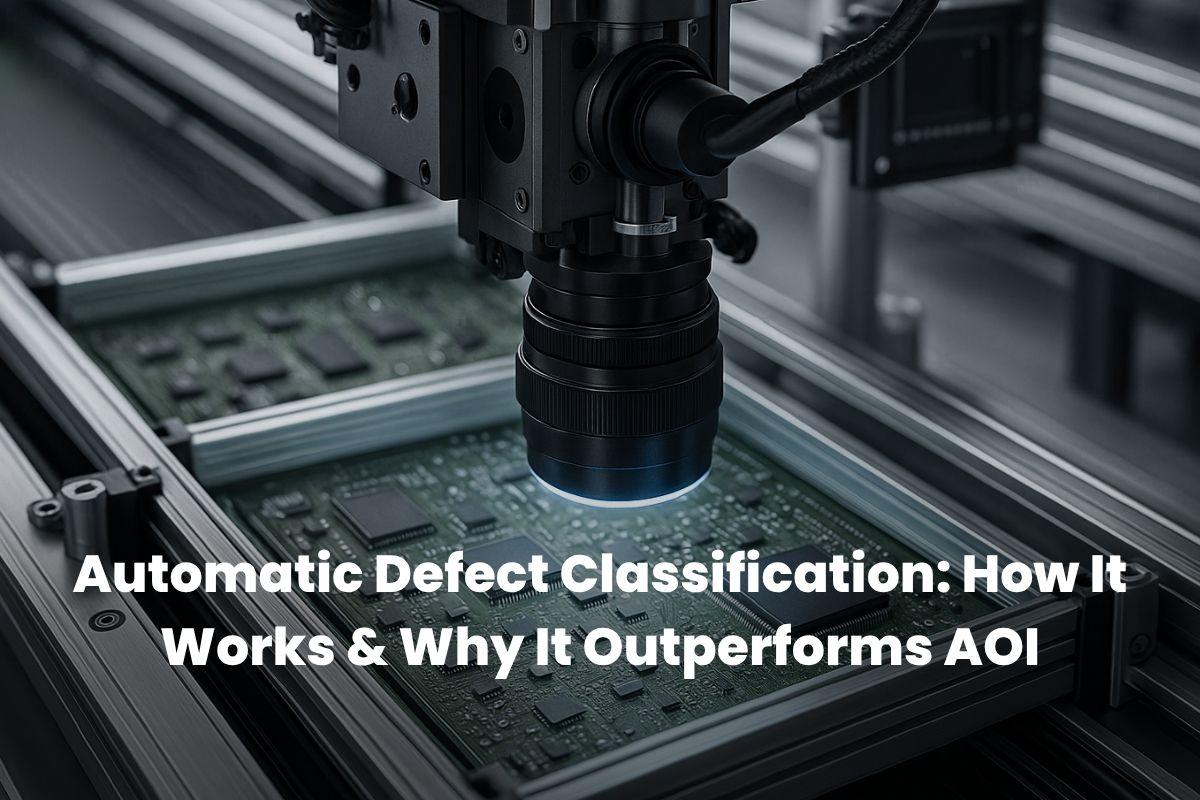
Existing line cameras capture images. Multi-spectrum illumination surfaces anomalies invisible under standard white light. No hardware changes.
2. Deep Learning Analysis
A CNN trained on your defect classes analyzes each image – learning the difference between real defects and benign surface variation.
That distinction is what kills false positives.
3. Simultaneous Detection & Classification
Defect type, location, and boundary – identified in one inference pass. Particles, scratches, bridging, voids, contamination – classified, not just flagged.
4. Confidence Scoring
High-confidence results route automatically. Edge cases go to a human review queue, so QA engineers focus where the model flags genuine uncertainty, not random spot checks.
5. Structured Data Output
Defect type, location, severity, confidence, timestamp – fed directly into MES, QMS, or your analytics stack.
Still Losing Hours To False Positive Reinspection?
See 99%+ accuracy and near-zero false positives – live on your line.
The numbers below reflect the generational difference between these approaches. Pay attention to the false positive column – that’s where the reinspection labor cost hides.
Metric
Manual Inspection
Rule-Based AOI
AI ADC (Averroes)
Throughput (inspections/hr)
~20
~1,800
2,200+
Classification accuracy
85%
90% (detection only)
99%+
False positive rate
10%
30–50%
<3%
Defect classification built-in
Manual step
Separate system
Yes – same pass
Smallest detectable defect
≥10 µm
≥1 µm
≥0.1 µm
New hardware required
—
Yes
No
5-year cost of ownership
$2.5M
$1.4M
$0.9M
Training data required
—
—
20–40 images/class
Why Automatic Defect Classification Changes Your Yield Economics
Reinspection labor disappears. Cutting false positives from 35% to under 3% returns your QA engineers to work that actually moves yield.
You catch more of what matters. ADC detects at 0.1 µm resolution – a submicron category rule-based systems miss entirely. Manufacturers consistently find 40–60% more submicron defects after switching.
Classification becomes a feedback loop. Structured, timestamped defect data enables trend analysis across process parameters – the foundation for Advanced Process Control.
The model improves over time. Active learning prioritizes edge cases for human review. The system running six months from now is more capable than the one you deploy on day one.
Implementing ADC: A Phased Approach That Works
ADC integrates with your current line – AOI, KLA, Onto, or proprietary tools. No infrastructure overhaul required.
Phase 1: Pilot On A Specific Line
Deploy on one high-volume or high-variability line. Train with 20–40 images per defect class. Measure false positive reduction and ROI against your current baseline.
Most pilots reach production-ready accuracy within weeks.
Phase 2: Hybrid – ADC Alongside Existing AOI
Run ADC in parallel with legacy inspection. Benchmark results against known ground truth, tune thresholds, build confidence.
Production data at this stage actively improves model accuracy.
Phase 3: Full Deployment
ADC becomes primary.
Detection, classification, and data output unified in one pipeline. This is where 300+ hours/month in labor savings materialize and MES/SCADA integration enables closed-loop process correction.
What About Defects Your Model Has Never Seen?
Manufacturing processes evolve. New failure modes appear. A model trained only on historical defect classes can miss genuinely novel anomalies – and pass them silently.
WatchDog Solves This
It’s an anomaly detection layer that flags anything outside all configured defect classes for human review, before it becomes a yield escape.
Novel defects become labeled training data, not escapes.
Is Your Inspection System Creating More Work Than It Solves?
99%+ accuracy, <3% false positives, live in weeks.
Solar – cell crack detection, interconnect defects, surface contamination
Food & beverage – contamination identification, fill-level verification, seal integrity
Oil & gas / remote inspection – pipeline defect categorization from drone or rover footage
Automatic Defect Classification FAQs
What is automatic defect classification and how is it different from AOI?
Automatic defect classification (ADC) uses deep learning to simultaneously detect and classify defects in a single image pass – identifying defect type, location, and confidence in real time. Traditional AOI uses rule-based algorithms to flag anomalies, but cannot classify them without a separate system or manual review step. ADC eliminates that secondary step and dramatically reduces false positives.
How much training data does an ADC model need?
Far less than most engineers expect. Averroes.ai’s ADC achieves high accuracy with as few as 20–40 images per defect class. Active learning then surfaces additional edge cases for labeling, so the model improves continuously without requiring large up-front data collection campaigns.
Does implementing ADC require new inspection hardware?
No. Averroes integrates with your existing AOI, KLA, Onto, and other inspection equipment. No new cameras, no new sensors, no infrastructure changes. The AI layer runs on top of what you already have, on-premise or in the cloud.
How does ADC help improve defect detection accuracy without increasing false positives?
This is the core value exchange. Deep learning models learn the difference between genuine defects and benign surface variation on your specific product – something rule-based systems can’t do. The result is higher sensitivity to real defects (catching more, at smaller sizes) while false positive rates drop from 30–50% on AOI to under 3% with ADC.
What happens when the system encounters a defect type it hasn’t seen before?
WatchDog, Averroes.ai’s anomaly detection layer, flags anything that falls outside all configured defect classes as an unknown. These are routed to a human review queue rather than passed silently. Once reviewed and labeled, they can be incorporated into the model as a new defect class – turning novel defects into training data rather than escapes.
Can ADC output integrate with MES and SCADA systems?
Yes. Structured classification output (defect type, location, severity, confidence score, timestamp) integrates directly with MES and SCADA systems via standard APIs. This is what enables Advanced Process Control: using inspection data to actively adjust upstream process parameters rather than just logging defects after the fact.
How long does deployment take?
Initial model training takes days to weeks depending on data availability. Full production deployment, including integration with existing equipment and MES, typically completes in 4 months – compared to 6 months for traditional AOI installation. Most customers see measurable false positive reduction within the first pilot phase.
Conclusion
Automatic defect classification isn’t an incremental upgrade on what AOI does. It’s a different category of tool.
One that doesn’t force you to choose between catching more defects and drowning in false positives. One that classifies in the same pass it detects, feeds structured data directly into your process stack, and gets sharper the longer it runs.
The economics follow: fewer reinspection hours, more submicron defects caught, and a quality signal that can actually drive process decisions rather than just log them.
If any part of this resonated – whether it’s the false positive rate, the hardware question, or just the idea of inspection data that does more than sit in a queue – it’s worth seeing it against your specific line.









If your inspection line is catching defects but drowning in false positives – or classifying them in a separate step – you’re paying a yield tax you don’t have to.
Automatic defect classification collapses detection and classification into one real-time AI step, on your existing equipment.
Key Notes
What Is Automatic Defect Classification?
Automatic defect classification (ADC) is an AI-powered inspection method that detects and classifies manufacturing defects simultaneously – in real time, from a single image pass.
ADC does both in one step using deep learning and computer vision, on your existing AOI, KLA, or Onto equipment.
No new hardware. No process changes.
ADC vs AOI:
Traditional AOI tells you that something looks wrong.
ADC tells you what it is, how severe, and how confident the model is – without a separate review step.
The Problem ADC Solves: False Positives At Scale
Rule-based AOI systems average 30–50% false positive rates.
Your QA team reinspects parts that are fine, instead of acting on real yield problems. And when AOI does catch a real defect, it can’t classify it – that’s a separate step, a separate queue, a separate delay.
Industry benchmark: Rule-based AOI averages 35% false positives. AI-powered ADC consistently delivers below 3% – without reducing sensitivity to real defects.
ADC closes both gaps: fewer false alarms, classification in the same pass, confidence-scored output your team can act on immediately.
How Automated Defect Classification Works
Five steps from image capture to actionable output – all in a single pipeline:
1. Image Acquisition
Existing line cameras capture images. Multi-spectrum illumination surfaces anomalies invisible under standard white light. No hardware changes.
2. Deep Learning Analysis
A CNN trained on your defect classes analyzes each image – learning the difference between real defects and benign surface variation.
That distinction is what kills false positives.
3. Simultaneous Detection & Classification
Defect type, location, and boundary – identified in one inference pass. Particles, scratches, bridging, voids, contamination – classified, not just flagged.
4. Confidence Scoring
High-confidence results route automatically. Edge cases go to a human review queue, so QA engineers focus where the model flags genuine uncertainty, not random spot checks.
5. Structured Data Output
Defect type, location, severity, confidence, timestamp – fed directly into MES, QMS, or your analytics stack.
Still Losing Hours To False Positive Reinspection?
See 99%+ accuracy and near-zero false positives – live on your line.
Book Free Demo Now
ADC vs AOI vs Manual: Performance Comparison
The numbers below reflect the generational difference between these approaches. Pay attention to the false positive column – that’s where the reinspection labor cost hides.
Why Automatic Defect Classification Changes Your Yield Economics
Implementing ADC: A Phased Approach That Works
ADC integrates with your current line – AOI, KLA, Onto, or proprietary tools. No infrastructure overhaul required.
Phase 1: Pilot On A Specific Line
Deploy on one high-volume or high-variability line. Train with 20–40 images per defect class. Measure false positive reduction and ROI against your current baseline.
Most pilots reach production-ready accuracy within weeks.
Phase 2: Hybrid – ADC Alongside Existing AOI
Run ADC in parallel with legacy inspection. Benchmark results against known ground truth, tune thresholds, build confidence.
Production data at this stage actively improves model accuracy.
Phase 3: Full Deployment
ADC becomes primary.
Detection, classification, and data output unified in one pipeline. This is where 300+ hours/month in labor savings materialize and MES/SCADA integration enables closed-loop process correction.
What About Defects Your Model Has Never Seen?
Manufacturing processes evolve. New failure modes appear. A model trained only on historical defect classes can miss genuinely novel anomalies – and pass them silently.
WatchDog Solves This
It’s an anomaly detection layer that flags anything outside all configured defect classes for human review, before it becomes a yield escape.
Novel defects become labeled training data, not escapes.
Is Your Inspection System Creating More Work Than It Solves?
99%+ accuracy, <3% false positives, live in weeks.
Industries Running Automated Defect Classification
ADC is not a semiconductor-only tool. Any manufacturing process generating consistent visual inspection data is a candidate:
Automatic Defect Classification FAQs
What is automatic defect classification and how is it different from AOI?
Automatic defect classification (ADC) uses deep learning to simultaneously detect and classify defects in a single image pass – identifying defect type, location, and confidence in real time. Traditional AOI uses rule-based algorithms to flag anomalies, but cannot classify them without a separate system or manual review step. ADC eliminates that secondary step and dramatically reduces false positives.
How much training data does an ADC model need?
Far less than most engineers expect. Averroes.ai’s ADC achieves high accuracy with as few as 20–40 images per defect class. Active learning then surfaces additional edge cases for labeling, so the model improves continuously without requiring large up-front data collection campaigns.
Does implementing ADC require new inspection hardware?
No. Averroes integrates with your existing AOI, KLA, Onto, and other inspection equipment. No new cameras, no new sensors, no infrastructure changes. The AI layer runs on top of what you already have, on-premise or in the cloud.
How does ADC help improve defect detection accuracy without increasing false positives?
This is the core value exchange. Deep learning models learn the difference between genuine defects and benign surface variation on your specific product – something rule-based systems can’t do. The result is higher sensitivity to real defects (catching more, at smaller sizes) while false positive rates drop from 30–50% on AOI to under 3% with ADC.
What happens when the system encounters a defect type it hasn’t seen before?
WatchDog, Averroes.ai’s anomaly detection layer, flags anything that falls outside all configured defect classes as an unknown. These are routed to a human review queue rather than passed silently. Once reviewed and labeled, they can be incorporated into the model as a new defect class – turning novel defects into training data rather than escapes.
Can ADC output integrate with MES and SCADA systems?
Yes. Structured classification output (defect type, location, severity, confidence score, timestamp) integrates directly with MES and SCADA systems via standard APIs. This is what enables Advanced Process Control: using inspection data to actively adjust upstream process parameters rather than just logging defects after the fact.
How long does deployment take?
Initial model training takes days to weeks depending on data availability. Full production deployment, including integration with existing equipment and MES, typically completes in 4 months – compared to 6 months for traditional AOI installation. Most customers see measurable false positive reduction within the first pilot phase.
Conclusion
Automatic defect classification isn’t an incremental upgrade on what AOI does. It’s a different category of tool.
One that doesn’t force you to choose between catching more defects and drowning in false positives. One that classifies in the same pass it detects, feeds structured data directly into your process stack, and gets sharper the longer it runs.
The economics follow: fewer reinspection hours, more submicron defects caught, and a quality signal that can actually drive process decisions rather than just log them.
If any part of this resonated – whether it’s the false positive rate, the hardware question, or just the idea of inspection data that does more than sit in a queue – it’s worth seeing it against your specific line.
Book a free demo with Averroes and bring your hardest classification problem.