Cognex vs Keyence [2026 Vision Inspection System Comparison]
Averroes
May 04, 2026
Cognex wins on customization, deep learning depth, and multi-camera flexibility. Keyence wins on speed of deployment, bundled support, and dead-simple setup.
They are the two best-known names in a machine vision market worth $15.83 billion in 2025, which makes the 2026 buying decision more about your team and inspection complexity than vendor capability.
Production-grade accuracy on submicron defects still requires an AI layer on top of either one. Here’s a breakdown of cognex vs keyence: full product lineups, real pricing bands, AI capabilities, and support models.
Cognex’s catalog runs four pillars – DataMan barcode, In-Sight 2D, 3D systems, and ViDi deep learning software.
Keyence centers on the VS, CV-X, and XG-X vision series, with ZoomTrax optical zoom on the VS.
Mid-range smart cameras run $8,000–15,000 for both vendors. Integration adds $20,000–150,000.
Overview: Cognex vs Keyence
Cognex
Keyence
Founded
1981 (Natick, MA)
1974 (Osaka, Japan)
Sales model
Distributors and integrators
Direct sales
Smart camera flagship
In-Sight 7000, In-Sight 9000
VS Series, CV-X, XG-X
3D flagship
3D-A5000, In-Sight L38
Multi-camera RGB projector systems
Deep learning tool
ViDi, ViDi EL
Native AI in CV-X and VS
Programming style
EasyBuilder + spreadsheet, VisionPro for PC
Flowchart-style (XG-X), one-click setup (VS)
Pricing transparency
None published
None published
Support model
Often paid annual contracts
Bundled, free on-site demos
Best for
Complex multi-camera cells, custom apps
Fast deployment, single-vendor simplicity
New to the category? Our guide to machine vision systems covers how these cameras, controllers, and software fit together.
Cognex Product Lineup: DataMan, In-Sight, 3D & ViDi
Cognex’s 2026 machine vision lineup spans four pillars: DataMan barcode readers, In-Sight 2D smart cameras (including the In-Sight 3800, launched in January 2024), 3D vision systems, and software, where VisionPro, ViDi deep learning, and the OneVision cloud platform carry much of the real value.
Here’s what each pillar contains in 2026:
DataMan Barcode Readers
Built to decode codes that shouldn’t be readable, running Cognex’s 1DMax, 2DMax, Hotbars, and PowerGrid algorithms across the line.
Fixed-mount:
DataMan 70: Ultra-compact for OEM equipment and tight machine spaces
DataMan 280: Mid-range workhorse for traceability on assembly lines
DataMan 300/360/370: High-speed, multi-code reading for dense logistics
Handheld:
DataMan 8050: General industrial scanning at workstations
DataMan 8070: DPM reading on metal (engine blocks, turbine blades)
DataMan 8700: Rugged build for the worst conditions you can throw at it
In-Sight 2D Smart Cameras
This is where most plant managers live. Seven tiers, each targeting a different complexity-and-resolution sweet spot:
In-Sight 2000: Entry-level vision sensor for basic pass/fail
In-Sight 2800: Embedded ViDi EL deep learning at smart-sensor simplicity
In-Sight 3800: High-speed system launched in January 2024, which Cognex rates at twice the processing speed of previous systems, combining edge learning and rule-based tools [NEW]
In-Sight 7000: 5MP with HDR+ and IP67 housing for harsh environments
In-Sight 8000: Same toolset, micro PoE form factor for tight spaces
In-Sight 8900: Higher-end model, and one of the first two systems supported by OneVision [NEW; SME verify the spec line]
In-Sight 9000: 12MP area scan or 32MP line scan for big parts and wide webs
3D Vision Systems
For dimensioning, surface inspection, and 3D guidance where 2D falls short:
3D-A1000: Logistics dimensioning and parcel cubing
3D-A5000: LightBurst projected pattern for high-resolution 3D capture
3D-L4000: Laser displacement with full VisionPro toolset for surface inspection
DS800 Series: Micron-level accuracy for precision electronics and connector coplanarity
Vision Software
Where Cognex hides a lot of its real value:
VisionPro: PC-based dev environment, supports cameras far beyond just Cognex
In-Sight software: EasyBuilder for beginners, spreadsheet interface for advanced users
ViDi / ViDi EL: Deep learning for cosmetic defects and complex OCR (full version in VisionPro, EL embedded in In-Sight 2800 and D900)
OneVision: Cloud platform for building, training, and scaling AI vision applications across sites. Announced in June 2025 for select In-Sight 3800 and 8900 customers, with broader availability rolling out in early 2026
Keyence Product Lineup: VS, CV-X, XG-X & A Catalog That Goes Wider
Keyence’s machine vision lineup centers on four series: the VS smart camera with ZoomTrax optical zoom, the high-speed CV-X systems, the modular XG-X controllers, and the PC-based VJ series. SR and BL barcode readers round it out, all sold direct with support bundled into the price.
Keyence is a broader company than Cognex.
Their machine vision pillar sits inside a catalog that also covers measurement sensors, microscopes, laser markers, safety, and even industrial 3D printers.
For vision specifically, four series matter.
Vision Systems
VS Series: The headline act. A smart camera with ZoomTrax, an optical zoom system using 19 internal lenses to auto-adjust field of view and focus with a click. No more manual lens swaps when you change parts. AI and rule-based tools in one environment, IP67 housing for the factory floor.
CV-X Series: High-speed cameras, AI plus rules-based tools, and the friendliest configuration software in the category. Where most Keyence vision buyers land for assembly verification and defect detection.
XG-X Series: The enterprise modular controller. Flowchart programming, support for line scan and 3D, cameras up to 64MP for large fields of view with fine detail.
VJ Series: PC-based environments. GigE cameras with LumiTrax dynamic lighting, compatible with HALCON, OpenCV, LabVIEW, and other major libraries if your team already standardizes on something else.
Barcode Readers
SR Series (including the SR-D100 for DPM): Fast-moving conveyors with Burst Read for difficult high-speed codes
BL-700: Long-range laser scanner reading at up to 1.2m
BL-180: Ultra-compact CCD reader at half a business card’s footprint
BL-1300: High-speed, high-resolution 1D reading
Cognex vs Keyence Pricing
As of 2026, mid-range smart cameras from Cognex and Keyence both run $8,000–15,000, entry units $2,000–6,000, and advanced AI or AOI configurations $15,000–50,000 or more. Integration usually adds $20,000–150,000 and often costs more than the hardware. Neither vendor publishes list prices, so these bands come from distributor data and independent comparisons.
Neither company publishes list prices, and they’re not going to start.
Both run configuration-driven, integrator-mediated sales models where the “right” price depends on your:
part
line speed
environment
how many cameras you’re buying
So here’s what current independent comparisons and distributor data show:
Tier
Cognex
Keyence
Entry smart camera
$3,000–6,000 (In-Sight 2000)
$2,000–4,000 (IV3 / basic VS)
Mid-range AI/multi-tool
$8,000–15,000 (In-Sight 7000)
$8,000–15,000 (CV-X)
Enterprise / advanced AOI
$15,000–50,000+ (D900/ViDi)
$20,000–40,000 (XG-X)
3D systems
$8,000–20,000 (In-Sight L38, 3D-A)
Included in advanced AOI band
Multi-line 3-year TCO
~$80,000
~$40,000
Keyence tends to come in slightly below Cognex at entry and mid-range, with support bundled into hardware cost.
For advanced AOI configurations specifically, one AOI-focused analysis puts Keyence higher, at $20,000–50,000 per camera versus $8,000–20,000 for Cognex, partly reflecting the support Keyence bundles into its hardware price. For full AOI cost breakdowns, see our AOI machine pricing guide.
A Few Things Move Pricing In Either Direction:
Resolution and dimensionality. 5–32MP cameras and 3D systems cost two to four times what entry 2D smart cameras do.
AI tier. Native deep learning (ViDi, CV-X AI) commands a premium over rule-based-only configurations.
Optics and lighting. Telecentric lenses, LumiTrax, and multi-spectrum illumination can add thousands per station.
Often the biggest line item on the quote – anywhere from $20,000 to $150,000 depending on complexity. For complex deployments, integration cost frequently exceeds hardware cost, which makes choosing a machine vision integrator part of the vendor decision.
AI & Deep Learning: Native Tools vs Real-World Limits
Cognex leads on deep learning depth with ViDi and, since 2025, the OneVision cloud training platform. Keyence leads on ease of use, with AI built directly into its CV-X and VS controllers. Both still typically need hundreds to thousands of labeled images per defect class, and both tie your AI roadmap to their hardware.
Both vendors have AI now.
The question is what their AI can do.
Cognex ViDi
The more mature deep learning platform of the two:
Full ViDi: Runs in VisionPro for PC-based cells, deepest customization
ViDi EL: Embedded in the In-Sight 2800 and D900 for sensor-simple deployment
OneVision (2025): Cloud environment for training AI vision apps and rolling them out across sites, launched on the In-Sight 3800 and 8900. It eases scaling, but the models still run on Cognex hardware
Strengths: Cosmetic defect detection, classification, anomaly detection, OCR on distorted text
Best fit: Subtle defects where rule-based tools get brittle
Keyence Native AI
Built into the vision systems themselves rather than a standalone tool:
Integrated into: CV-X and VS Series controllers
Approach: AI and rule-based logic mixed in one environment
Strengths: Faster to set up than ViDi, lower learning curve
Limitations: Less flexible when you need to tune for novel defect types or push into complex multi-class problems
Training data hunger: You typically need hundreds to thousands of labeled images per defect class to get production-grade accuracy.
Vendor lock-in: Your AI roadmap is tied to their hardware refresh cycle.
Unknown defects slip through: Anomalies that fall outside your trained classes aren’t flagged. If you didn’t train for it, the system doesn’t see it.
How AI Visual Inspection Closes The Accuracy Gap
Native AI has real ceilings – training data demands, vendor lock-in, blind spots on unknowns. A third-party AI visual inspection layer is one way around them.
Averroes is a no-code AI platform that runs on your existing Cognex or Keyence equipment – no new hardware needed.
Here’s what that does to the spec sheet:
Capability
Cognex or Keyence Alone
With Averroes
Classification accuracy
Varies by application
99%+
Object detection accuracy
Varies by application
98.5%+
Training images per class
Hundreds to thousands
20–40
Reinspection labor
Standard
300+ hours per month saved per application
Unknown defect detection
Rule-based: misses novel anomalies
WatchDog flags anything outside trained classes
Hardware required
Vendor lock-in
Works with existing Cognex and Keyence tools
Deployment
Proprietary stack
On-prem (air-gapped supported), cloud, or cloud-agnostic
What That Looks Like In Production
At Tekscend Photomask, Averroes reached 99.993% accuracy across 1.4 million images processed over 13 months, with defect review running 8x faster than before. Those are production numbers from a live mask shop, not a benchmark dataset.
Support, Training & The Real Cost of Ownership
Cognex sells through distributors and integrators and often charges for annual support contracts. Keyence sells direct and bundles on-site demos, training, and applications support into the hardware price. In practice, Cognex suits teams with in-house vision engineers, and Keyence suits teams that want the vendor to carry more of the setup work.
The buying experience is genuinely different between these two.
Cognex
Sales channel: Distributors and integrators rather than direct
Support: Often structured as a paid annual contract
Training catalog: Deep, with dedicated tracks for In-Sight Vision Suite, VisionPro Deep Learning, and Cognex Designer Programming
Learning curve: VisionPro is powerful but steep
The trade-off: More flexibility and customization in exchange for more engineering time on your side
Keyence
Sales channel: Direct, no middlemen
Support: Free on-site demos, free training, applications support bundled into hardware pricing
Annual support cost: Typically $0 on their TCO sheets, baked into the hardware price instead
The trade-off: Opaque pricing and a sales process some buyers describe as more aggressive than they’d like
If you have a strong CV engineering team, Cognex’s flexibility usually wins.
If you don’t, Keyence’s hand-holding often pays for itself.
Cognex and Keyence Alternatives
The main alternatives to Cognex and Keyence are Zebra (which acquired Matrox Imaging in 2022), Basler, Omron, SICK, Teledyne DALSA, Datalogic, Banner, and MVTec’s HALCON software. Teams that want to keep their existing Cognex or Keyence cameras can add an AI inspection layer instead, from vendors such as Averroes, Landing AI, or Instrumental.
Alternative
Type
Best For
Zebra (Matrox Imaging)
Smart cameras, 3D sensors, vision controllers, software
Plants already standardized on Zebra scanning and automation hardware
Basler
Industrial area and line scan cameras
PC-based builds where your team picks its own vision software
Need multi-camera cells, custom programming, line scan for wide webs or large parts, or you’re standardizing vision across a large engineering team that can handle VisionPro.
Choose Keyence If You…
Need fast deployment, single-vendor support, simpler workflows for non-specialist operators, and you’d rather not staff a deep computer vision team in-house.
Choose Neither Alone If You…
Need 99%+ accuracy on submicron defects, you can’t afford the reinspection labor your current false positives are creating, or you’re seeing escapes that rule-based tools keep missing. Either platform pairs with Averroes.
Cognex, Keyence, or Something Else Entirely?
Hit 99%+ accuracy on whatever inspection system you already run
Cognex vs Keyence FAQs
Is Cognex better than Keyence?
Neither is better across the board. Cognex is the stronger choice for complex multi-camera cells and teams with in-house vision engineers who want deep customization and the ViDi or OneVision AI tools. Keyence is the stronger choice when fast deployment, bundled support, and simple setup for non-specialist operators matter most.
Who are the main competitors to Cognex and Keyence?
The main competitors to Cognex and Keyence include Basler, Omron, Teledyne DALSA, Sick, and MVTec. In the deep learning and AI inspection layer specifically, Averroes is a hardware-agnostic alternative that runs on existing Cognex and Keyence equipment rather than competing with it.
What is Cognex’s market share in machine vision?
Cognex is one of the two leading players in the global machine vision market alongside Keyence, with the top five companies (Cognex, Keyence, Teledyne, Basler, and Omron) collectively controlling 20–30% [link kept: marketsandmarkets.com] of total share. The overall market is projected to grow from $15.83B in 2025 to $23.63B by 2030 at an 8.3% CAGR, so individual share is fragmented across a long tail of specialist vendors.
Can Cognex and Keyence systems read DPM codes on metal parts?
Yes, both Cognex and Keyence offer dedicated DPM readers for laser-marked and dot-peened codes on metal. Cognex’s DataMan 8070 handheld is purpose-built for engine blocks, turbines, and structural parts. Keyence’s SR-D100 covers fixed-mount DPM reading at conveyor speed.
How accurate is Keyence AI vision for defect detection?
Keyence AI vision is marketed for high-accuracy defect detection but doesn’t publish a universal percentage – actual performance depends on application complexity, lighting stability, and training data quality. Third-party comparisons and case studies typically report mid-to-high 90% detection rates once tuned for a specific application. A dedicated AI inspection layer like Averroes can lift either Keyence or Cognex setups to 99%+ accuracy with 20–40 training images per class.
Conclusion
Cognex vs Keyence isn’t a single-winner question.
Cognex gives you depth, multi-camera flexibility, and a deep learning platform built for engineering teams that want to customize. Keyence gives you speed, simplicity, and a sales process designed to get you up and running without a CV specialist on staff.
Both are credible. Neither solves for unknown defects, neither escapes the training data ceiling, and neither alone reliably hits 99%+ on submicron work.
That last gap is where most plants are quietly losing yield. Averroes lifts whatever you already run to 99%+ accuracy (99.993% in production at Tekscend Photomask) and saves 300+ hours of reinspection labor a month. Book a free demo and see what your existing line is capable of.




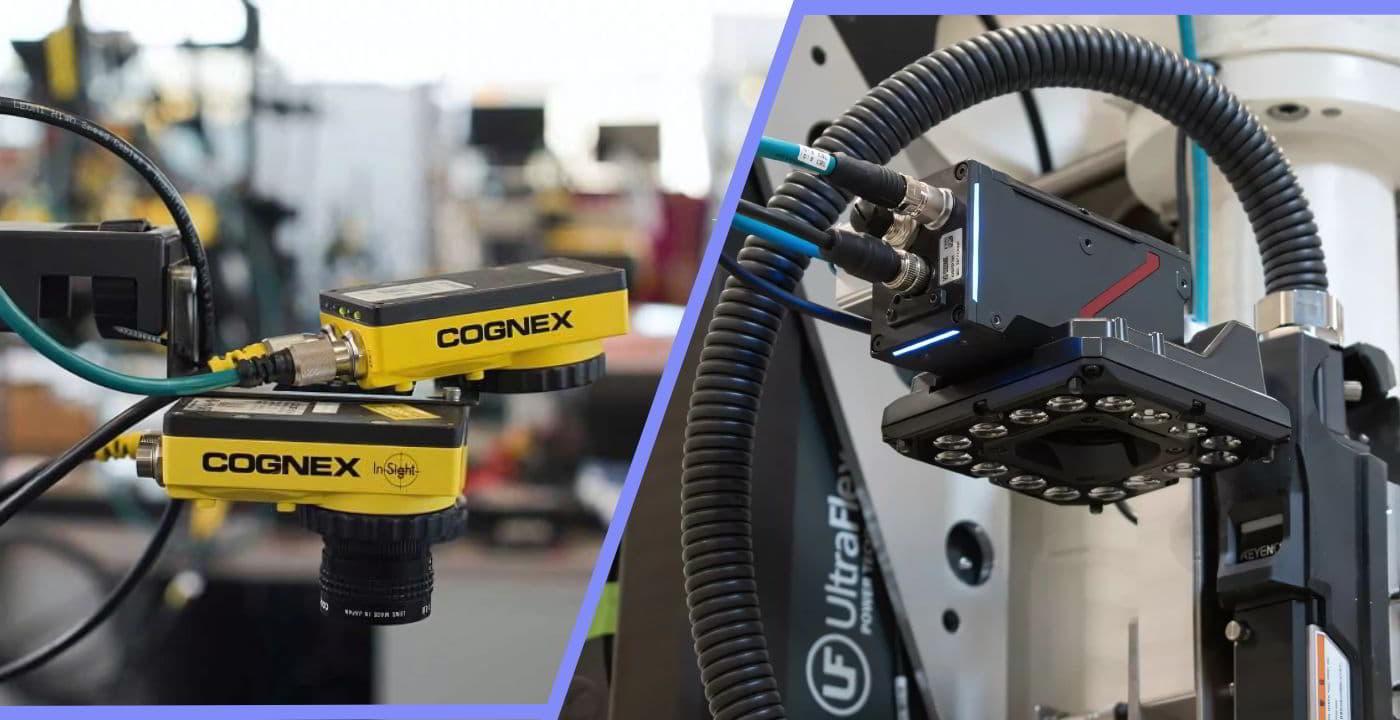




Cognex wins on customization, deep learning depth, and multi-camera flexibility. Keyence wins on speed of deployment, bundled support, and dead-simple setup.
They are the two best-known names in a machine vision market worth $15.83 billion in 2025, which makes the 2026 buying decision more about your team and inspection complexity than vendor capability.
Production-grade accuracy on submicron defects still requires an AI layer on top of either one. Here’s a breakdown of cognex vs keyence: full product lineups, real pricing bands, AI capabilities, and support models.
For the wider vendor landscape, see our guide to the top machine vision companies.
Key Notes
Overview: Cognex vs Keyence
New to the category? Our guide to machine vision systems covers how these cameras, controllers, and software fit together.
Cognex Product Lineup: DataMan, In-Sight, 3D & ViDi
Cognex’s 2026 machine vision lineup spans four pillars: DataMan barcode readers, In-Sight 2D smart cameras (including the In-Sight 3800, launched in January 2024), 3D vision systems, and software, where VisionPro, ViDi deep learning, and the OneVision cloud platform carry much of the real value.
Here’s what each pillar contains in 2026:
DataMan Barcode Readers
Built to decode codes that shouldn’t be readable, running Cognex’s 1DMax, 2DMax, Hotbars, and PowerGrid algorithms across the line.
Fixed-mount:
Handheld:
In-Sight 2D Smart Cameras
This is where most plant managers live. Seven tiers, each targeting a different complexity-and-resolution sweet spot:
3D Vision Systems
For dimensioning, surface inspection, and 3D guidance where 2D falls short:
Vision Software
Where Cognex hides a lot of its real value:
Keyence Product Lineup: VS, CV-X, XG-X & A Catalog That Goes Wider
Keyence’s machine vision lineup centers on four series: the VS smart camera with ZoomTrax optical zoom, the high-speed CV-X systems, the modular XG-X controllers, and the PC-based VJ series. SR and BL barcode readers round it out, all sold direct with support bundled into the price.
Keyence is a broader company than Cognex.
Their machine vision pillar sits inside a catalog that also covers measurement sensors, microscopes, laser markers, safety, and even industrial 3D printers.
For vision specifically, four series matter.
Vision Systems
Barcode Readers
Cognex vs Keyence Pricing
As of 2026, mid-range smart cameras from Cognex and Keyence both run $8,000–15,000, entry units $2,000–6,000, and advanced AI or AOI configurations $15,000–50,000 or more. Integration usually adds $20,000–150,000 and often costs more than the hardware. Neither vendor publishes list prices, so these bands come from distributor data and independent comparisons.
Neither company publishes list prices, and they’re not going to start.
Both run configuration-driven, integrator-mediated sales models where the “right” price depends on your:
So here’s what current independent comparisons and distributor data show:
Keyence tends to come in slightly below Cognex at entry and mid-range, with support bundled into hardware cost.
For advanced AOI configurations specifically, one AOI-focused analysis puts Keyence higher, at $20,000–50,000 per camera versus $8,000–20,000 for Cognex, partly reflecting the support Keyence bundles into its hardware price. For full AOI cost breakdowns, see our AOI machine pricing guide.
A Few Things Move Pricing In Either Direction:
AI & Deep Learning: Native Tools vs Real-World Limits
Cognex leads on deep learning depth with ViDi and, since 2025, the OneVision cloud training platform. Keyence leads on ease of use, with AI built directly into its CV-X and VS controllers. Both still typically need hundreds to thousands of labeled images per defect class, and both tie your AI roadmap to their hardware.
Both vendors have AI now.
The question is what their AI can do.
Cognex ViDi
The more mature deep learning platform of the two:
Keyence Native AI
Built into the vision systems themselves rather than a standalone tool:
The Shared Limits
Both platforms hit the same wall in production (for the underlying trade-off, see AI vs rule-based machine vision:
How AI Visual Inspection Closes The Accuracy Gap
Native AI has real ceilings – training data demands, vendor lock-in, blind spots on unknowns. A third-party AI visual inspection layer is one way around them.
Averroes is a no-code AI platform that runs on your existing Cognex or Keyence equipment – no new hardware needed.
Here’s what that does to the spec sheet:
What That Looks Like In Production
At Tekscend Photomask, Averroes reached 99.993% accuracy across 1.4 million images processed over 13 months, with defect review running 8x faster than before. Those are production numbers from a live mask shop, not a benchmark dataset.
Support, Training & The Real Cost of Ownership
Cognex sells through distributors and integrators and often charges for annual support contracts. Keyence sells direct and bundles on-site demos, training, and applications support into the hardware price. In practice, Cognex suits teams with in-house vision engineers, and Keyence suits teams that want the vendor to carry more of the setup work.
The buying experience is genuinely different between these two.
Cognex
Keyence
If you have a strong CV engineering team, Cognex’s flexibility usually wins.
If you don’t, Keyence’s hand-holding often pays for itself.
Cognex and Keyence Alternatives
The main alternatives to Cognex and Keyence are Zebra (which acquired Matrox Imaging in 2022), Basler, Omron, SICK, Teledyne DALSA, Datalogic, Banner, and MVTec’s HALCON software. Teams that want to keep their existing Cognex or Keyence cameras can add an AI inspection layer instead, from vendors such as Averroes, Landing AI, or Instrumental.
For a wider vendor list, see our guide to the top machine vision companies. Omron gets its own breakdown in our Omron machine vision guide.
Cognex vs Keyence: Which Should You Choose?
Choose Cognex If You…
Need multi-camera cells, custom programming, line scan for wide webs or large parts, or you’re standardizing vision across a large engineering team that can handle VisionPro.
Choose Keyence If You…
Need fast deployment, single-vendor support, simpler workflows for non-specialist operators, and you’d rather not staff a deep computer vision team in-house.
Choose Neither Alone If You…
Need 99%+ accuracy on submicron defects, you can’t afford the reinspection labor your current false positives are creating, or you’re seeing escapes that rule-based tools keep missing. Either platform pairs with Averroes.
Cognex, Keyence, or Something Else Entirely?
Hit 99%+ accuracy on whatever inspection system you already run
Cognex vs Keyence FAQs
Is Cognex better than Keyence?
Neither is better across the board. Cognex is the stronger choice for complex multi-camera cells and teams with in-house vision engineers who want deep customization and the ViDi or OneVision AI tools. Keyence is the stronger choice when fast deployment, bundled support, and simple setup for non-specialist operators matter most.
Who are the main competitors to Cognex and Keyence?
The main competitors to Cognex and Keyence include Basler, Omron, Teledyne DALSA, Sick, and MVTec. In the deep learning and AI inspection layer specifically, Averroes is a hardware-agnostic alternative that runs on existing Cognex and Keyence equipment rather than competing with it.
What is Cognex’s market share in machine vision?
Cognex is one of the two leading players in the global machine vision market alongside Keyence, with the top five companies (Cognex, Keyence, Teledyne, Basler, and Omron) collectively controlling 20–30% [link kept: marketsandmarkets.com] of total share. The overall market is projected to grow from $15.83B in 2025 to $23.63B by 2030 at an 8.3% CAGR, so individual share is fragmented across a long tail of specialist vendors.
Can Cognex and Keyence systems read DPM codes on metal parts?
Yes, both Cognex and Keyence offer dedicated DPM readers for laser-marked and dot-peened codes on metal. Cognex’s DataMan 8070 handheld is purpose-built for engine blocks, turbines, and structural parts. Keyence’s SR-D100 covers fixed-mount DPM reading at conveyor speed.
How accurate is Keyence AI vision for defect detection?
Keyence AI vision is marketed for high-accuracy defect detection but doesn’t publish a universal percentage – actual performance depends on application complexity, lighting stability, and training data quality. Third-party comparisons and case studies typically report mid-to-high 90% detection rates once tuned for a specific application. A dedicated AI inspection layer like Averroes can lift either Keyence or Cognex setups to 99%+ accuracy with 20–40 training images per class.
Conclusion
Cognex vs Keyence isn’t a single-winner question.
Cognex gives you depth, multi-camera flexibility, and a deep learning platform built for engineering teams that want to customize. Keyence gives you speed, simplicity, and a sales process designed to get you up and running without a CV specialist on staff.
Both are credible. Neither solves for unknown defects, neither escapes the training data ceiling, and neither alone reliably hits 99%+ on submicron work.
That last gap is where most plants are quietly losing yield. Averroes lifts whatever you already run to 99%+ accuracy (99.993% in production at Tekscend Photomask) and saves 300+ hours of reinspection labor a month. Book a free demo and see what your existing line is capable of.