Undetected faults cost money silently and steadily.
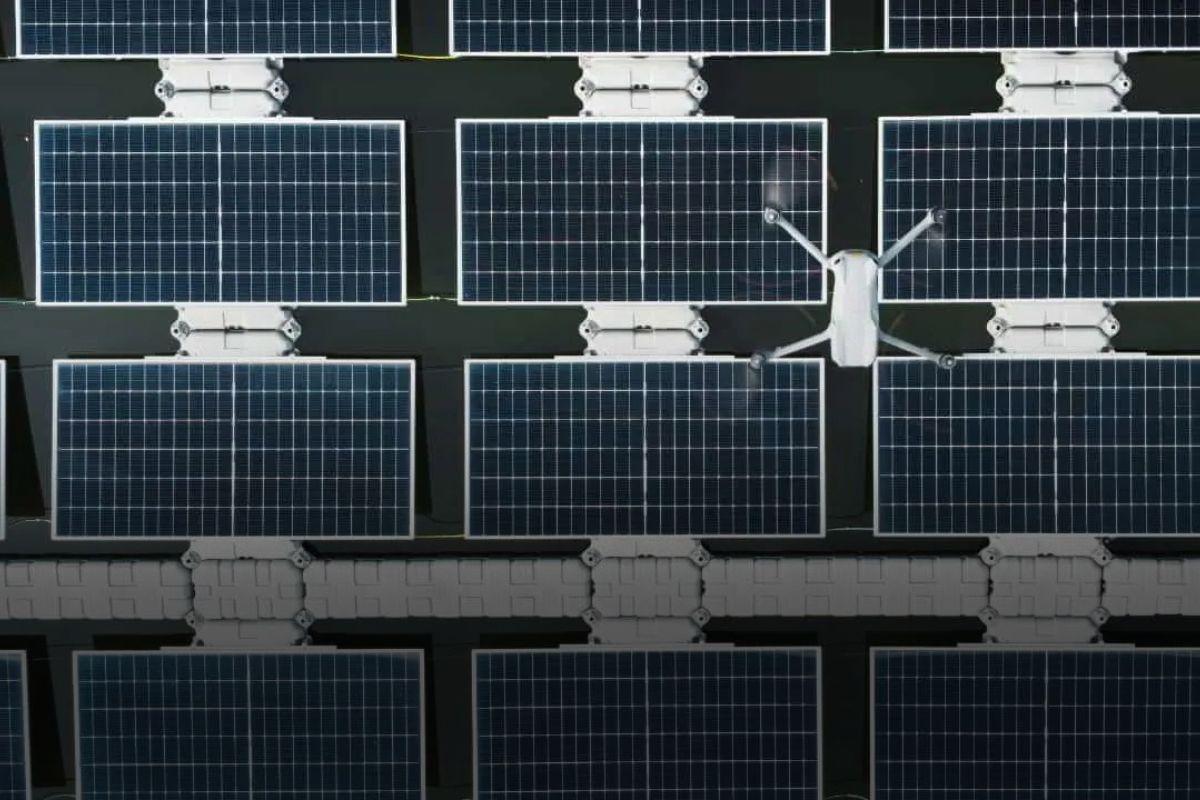
Drone solar panel inspection strips away the guesswork between ground coverage and what thermal data actually reveals (but only if execution and post-flight analysis are disciplined).
The hardware exists. The harder question is what gets detected, how fast analysis scales, and what ROI looks like when data processing is right.
We’ll cover the operational picture from flight planning through report delivery: technology, process, standards, and economics.
Key Notes
Drone solar panel inspection covers 10x more panels per hour than manual ground-level methods.
5% undetected yield loss on 10 MW costs $40,000 annually – inspection pays back in weeks.
Why Drones Replaced Manual Solar Inspection
Manual inspection has hard limits that no amount of diligence can overcome.
A technician on the ground covering 200–400 panels per hour faces time constraints, safety risk, and physical fatigue that compounds inconsistency.
Drone solar panel inspection sits in a different category entirely – it delivers 10x coverage speed, full-site data in a single flight, and repeatability that grounds the work in defensible standards.
The Comparison Is Stark:
Method
Coverage Rate
Cost per MW
Safety Risk
Manual (handheld IR)
200–400 panels/hr
High
Moderate–High
Drone inspection
2,000–5,000 panels/hr
Low–Moderate
Low
Satellite imaging
Full site
Low
None
Satellite monitoring plays a role for long-term trend tracking, but lacks resolution for panel-level fault detection.
Manual inspection remains necessary for targeted follow-up work on the ground.
Drone solar panel inspection occupies the middle ground – scalable enough for utility and commercial sites, precise enough to justify annual or biannual full-site assessments on almost any asset class.
What Does Drone Inspection Detect?
Drone solar panel inspection relies on two sensor types working in parallel:
thermal cameras find electrical faults via heat signature
RGB imagery catches physical damage
Together, they cover roughly 95% of yield-loss triggers (which is why professional operators use both).
Thermal Cameras…
Detect anomalies by measuring emissivity differences across panel surfaces.
A healthy cell emits heat uniformly when under load; a failing cell doesn’t. The temperature differential is the signal.
What Thermal Imaging Reveals:
Hotspots are localized overheating (cell, subcell, or soldering defects) that accelerate failure if unchecked.
Bypass diode failures show up as a thermal signature across roughly one-third of the panel – very distinctive once you know what to look for.
String faults appear as an entire string running cold or hot, the clearest drone signature for electrical problems.
PID (potential-induced degradation) manifests as a pattern of underperforming cells visible at string level.
RGB Imaging…
Catches what thermal misses:
cracked glass
delamination
physical frame damage
soiling patterns
vegetation overgrowth
wiring issues
When thermal and RGB are processed together, the defect picture becomes complete.
Honest Scope-Setting:
Drones screen at the site level. They don’t replace IV curve tracing for deep electrical characterization or inverter-level monitoring for real-time performance tracking.
Ground follow-up (panel replacement, cleaning, targeted testing) still happens off the drone data. The drone’s job is to tell you where to focus.
How Drone Solar Panel Inspections Execute
A professional drone solar panel inspection unfolds in three distinct phases, each with its own discipline and risk factors.
Phase 1: Pre-Flight Planning (days before takeoff)
The foundation of a good flight is laid on the ground, days in advance. You need complete site data before you can plan a repeatable flight path.
Essential Pre-Flight Tasks:
Site survey and flight path planning require as-built drawings, string layouts, and any available GIS or CAD data to define boundaries, blocks, and string groupings. Without this reference, your flight path becomes reactive instead of systematic.
Irradiance forecasting is non-negotiable because IEC 62446-3 sets a minimum of 600 W/m² plane-of-array irradiance for valid thermal data. Below that threshold, panel temperature differentials are too small for reliable fault detection, which means your entire dataset becomes unreliable.
Weather documentation requires ambient temperature, wind conditions, and cloud cover logged before and during the flight so later analysis can contextualize the temperature differences you see in thermal imagery.
Wind Assessment Matters Because Wind Cools Hotspots
Above roughly 5 m/s, thermal signatures compress and faults become harder to distinguish.
Regulatory clearances – FAA Part 107 in the US, EASA certification in Europe, local civil aviation authority rules elsewhere – take days to confirm for some sites, especially near airports or controlled airspace.
Phase 2: During Inspection (controlled flight execution)
Flight parameters are tightly controlled to ensure repeatable, high-quality data. Every variable affects what you capture.
Flight Parameter
Range
Why It Matters
Altitude
10–30 m
Determines cell-level anomaly resolution; higher altitude = less detail
Airspeed
3–7 m/s
Controls thermal exposure time per panel; too fast blurs thermal gradients, too slow wastes battery
Image Overlap
20–30% minimum
Ensures complete coverage with no gaps; every panel appears in multiple frames
Real-time QA during flight is critical because it catches problems before you leave the site.
Sample image review in the field checks focus, exposure, thermal range, and gimbal positioning – if something’s wrong, you can fly an immediate second pass rather than discovering the problem in post-processing hours later.
Phase 3: Post-Flight (data organization and analysis)
Raw datasets need immediate backup to redundant storage or secure cloud environments. Losing a full-site inspection dataset to a laptop failure or corrupted memory card is expensive and unrepeatable.
Data Handling Workflow:
Organize by structure: Site, date, and block, with RGB and thermal imagery in consistent directory structures so nothing gets lost or duplicated downstream.
Verify coverage before analysis begins: Most modern platforms provide upload portals where you can drag-and-drop thermal and RGB sets and see a coverage footprint, which catches gaps immediately.
Turnaround time depends on analysis method.
With AI-assisted defect detection, professional reports turn in 24–72 hours. Manual-only review at large sites stretches to a week or more, which is why manual analysis has become the bottleneck rather than the flight itself.
Data Quality & Standards
IEC 62446-3 is the international baseline for thermographic inspection of photovoltaic systems. It defines minimum irradiance conditions, temperature delta thresholds for fault classification, and camera specifications.
If an inspection provider can’t reference this standard, that tells you something.
What IEC 62446-3 Requires
This standard sets the floor for defensible thermal inspection data:
Irradiance minimum of 600 W/m² plane-of-array, measured with a pyranometer, not just “sunny outside” – this threshold ensures panel temperature differentials are large enough to detect faults reliably.
Temperature delta thresholds that classify hotspots by severity (typically 5–10°C delta for actionable defects), so you have a consistent, documented basis for prioritizing remediation.
Radiometric thermal cameras that capture temperature data per pixel, not just heat maps, enabling quantitative temperature analysis downstream.
RTK GPS for centimeter-level positioning accuracy so defects geo-tag precisely to panel coordinates in your asset records.
Environmental Conditions for Valid Data
Valid thermal data goes beyond just “good weather.”
Early morning and late afternoon introduce angle-related thermal artifacts that skew readings.
Wind compression of thermal signatures means faults become harder to detect as wind speeds climb (above 5 m/s, the signal degrades significantly).
Irradiance matters more than “it’s a clear day.” 600 W/m² is the actual floor, not a suggestion.
A competent operator documents all conditions – ambient temperature, wind speed, cloud cover, time of day – as part of the inspection record so analysis can contextualize what the thermal imagery shows.
Equipment Specifications
Professional equipment determines what analysis is possible downstream, so specs matter.
Thermal cameras need at least 640×512 pixel resolution and radiometric capability to detect cell-level anomalies and enable quantitative temperature analysis – resolution below that becomes too coarse for actionable defect classification.
RGB cameras should be high-resolution for mapping context and visual confirmation of physical damage like cracked glass, delamination, and soiling patterns.
Pyranometer mounted on the drone logs plane-of-array irradiance during the flight, giving you the exact conditions under which data was captured rather than relying on ground station estimates.
From Raw Data To Actionable Reports
The bottleneck in drone solar panel inspection has shifted away from the flight itself.
UAV hardware and sensors are mature. The limiting factor now is what happens after the drone lands.
Why Manual Review Doesn’t Scale
Manual thermal image review creates a cascade of problems that undermines the efficiency gains from the drone flight itself.
A trained analyst reviewing thousands of images from a 10 MW site introduces:
fatigue-related inconsistency
cost overhead that eats half the savings from drone efficiency
review cycles that stretch timelines
Panel-by-panel manual review at that volume isn’t viable – it’s just not economically defensible.
What AI-Powered Defect Detection Changes
AI automates classification at the panel level, applying consistent criteria across every image, every time.
Instead of an analyst deciding whether a 3°C hotspot matters or flagging ambiguous anomalies as false positives that send out unnecessary dispatch calls, the algorithm applies the same threshold to every panel consistently.
What AI-Assisted Analysis Delivers:
Automated defect classification labels fault type (hotspot, string fault, PID, etc.), not just “anomaly detected” – your report tells technicians what they’re looking at, not just where the problem is.
Panel-level geo-referencing maps defects directly to asset records and site layouts so technicians know exactly which panel to walk to.
Near-zero false positives mean every dispatch call is a legitimate defect, not wasted resources or technician time on phantom issues.
Trend monitoring tracks whether a fault is stable, worsening, or new since the last inspection cycle – you catch degradation patterns, not just isolated defects.
What A Professional Report Includes
A drone solar panel inspection report with AI analysis delivers everything the O&M team needs to prioritize and act:
Economics & Inspection Cadence
The math on solar panel inspection cost is straightforward, and it tends to surprise people unfamiliar with the numbers.
The Cost of Undetected Faults
A 5% undetected yield loss on a 10 MW site generating $800,000 per year costs $40,000 annually in lost revenue.
Hotspots, string faults, and PID can reduce individual panel output by 5–30% before inverter-level monitoring flags anything. That silent loss compounds month after month.
Solar Panel Inspection Cost Breakdown
A professional drone solar panel inspection typically costs $150–500 per MW depending on site complexity, location, report depth, and whether AI-assisted analysis is included. On a 10 MW commercial site, budget $1,500–5,000 for a full thermographic inspection with a professional defect report.
Cost drivers vary by region and travel distance, but the payback window is typically measured in weeks.
A single inspection often pays for itself before the next inspection cycle begins.
Recommended Inspection Frequency By Asset Type
Cadence depends on asset scale and yield exposure:
Utility-scale (>10 MW): Twice per year, aligned to peak production periods and post-summer for degradation trends – these sites have the highest yield exposure, so more frequent monitoring justifies itself.
Commercial (1–10 MW): Annually, plus post-storm assessments after significant weather events – balances detection with cost-effectiveness at mid-scale.
Rooftop (<100 kW): Every 2–3 years or triggered by performance anomalies – lower volume assets can stretch cadence while staying ahead of silent faults.
Long-Term Asset Intelligence
Beyond the immediate fault list, a single inspection dataset feeds into longer-term strategic value.
Inspection data:
informs cleaning schedule optimization
supports warranty claims and insurance assessments
enables end-of-life planning and asset valuation
reveals degradation trends across inspection cycles
The first report is the entry point.
The long-term asset intelligence – tracking how faults evolve, how cleaning affects performance, how aging compounds yield – is where ROI compounds. Sites treating inspections as a one-off compliance exercise leave significant value on the table.
Ready To Cut Inspection Costs By 70%?
Get 95%+ accuracy with zero new hardware investment or integration headaches
Drone Solar Panel Inspection FAQs
What type of drone works best for solar panel inspection?
Both fixed-wing and multirotor drones work for solar panel inspection – fixed-wing covers large utility sites faster, multirotors suit rooftop and complex geometry. What matters most is radiometric thermal cameras, RTK GPS, and disciplined flight execution. A well-flown standard platform outperforms a poorly-operated high-end drone.
How accurate is AI for detecting solar panel defects?
Enterprise-grade AI detects 98.5%+ of panel-level defects with false positive rates below 2%, compared to 60–80% from manual thermal analysis prone to fatigue-induced misses. Accuracy depends heavily on thermal image quality, which is why IEC 62446-3 compliance and proper equipment matter more than the AI itself.
How long does a solar panel drone inspection take from flight to final report?
Flight time runs 2–4 hours for a 10 MW site plus 6–8 hours pre-flight planning and preparation. AI-powered post-flight analysis delivers professional reports in 24–72 hours; manual review extends to one week or longer. Total timeline from scheduling to actionable report is typically 3–5 business days.
What qualifications should a solar panel inspection provider have?
Look for IEC 62446-3 compliance (proves standards adherence), radiometric thermal cameras (not just heat maps), RTK GPS (precise defect location), and AI-assisted post-processing (ensures consistency and speed). Providers who can’t articulate why these matter lack essential capability for defensible inspections.
Conclusion
Drone solar panel inspection technology has matured. The hardware works. Flight execution is repeatable. The differentiator in 2026 isn’t the flight itself, but what happens after the data lands.
Sites extracting genuine ROI process data smarter, inspect on a defensible cadence, and treat thermal imagery as an operational asset rather than a compliance checkbox. Whether you’re managing utility-scale portfolios or commercial rooftops, the economics work if your analysis matches your scope.
If cutting turnaround time, improving defect classification consistency, or eliminating manual review bottlenecks are priorities for your program, Averroes processes thermal and RGB drone imagery with 98.5% detection accuracy and sub-2% false positives – delivering actionable reports ready for your team to execute against. Book your free demo now.






Undetected faults cost money silently and steadily.
Drone solar panel inspection strips away the guesswork between ground coverage and what thermal data actually reveals (but only if execution and post-flight analysis are disciplined).
The hardware exists. The harder question is what gets detected, how fast analysis scales, and what ROI looks like when data processing is right.
We’ll cover the operational picture from flight planning through report delivery: technology, process, standards, and economics.
Key Notes
Why Drones Replaced Manual Solar Inspection
Manual inspection has hard limits that no amount of diligence can overcome.
The Comparison Is Stark:
Satellite monitoring plays a role for long-term trend tracking, but lacks resolution for panel-level fault detection.
Manual inspection remains necessary for targeted follow-up work on the ground.
Drone solar panel inspection occupies the middle ground – scalable enough for utility and commercial sites, precise enough to justify annual or biannual full-site assessments on almost any asset class.
What Does Drone Inspection Detect?
Drone solar panel inspection relies on two sensor types working in parallel:
Together, they cover roughly 95% of yield-loss triggers (which is why professional operators use both).
Thermal Cameras…
Detect anomalies by measuring emissivity differences across panel surfaces.
A healthy cell emits heat uniformly when under load; a failing cell doesn’t. The temperature differential is the signal.
What Thermal Imaging Reveals:
RGB Imaging…
Catches what thermal misses:
When thermal and RGB are processed together, the defect picture becomes complete.
Honest Scope-Setting:
Drones screen at the site level. They don’t replace IV curve tracing for deep electrical characterization or inverter-level monitoring for real-time performance tracking.
Ground follow-up (panel replacement, cleaning, targeted testing) still happens off the drone data. The drone’s job is to tell you where to focus.
How Drone Solar Panel Inspections Execute
A professional drone solar panel inspection unfolds in three distinct phases, each with its own discipline and risk factors.
Phase 1: Pre-Flight Planning (days before takeoff)
The foundation of a good flight is laid on the ground, days in advance. You need complete site data before you can plan a repeatable flight path.
Essential Pre-Flight Tasks:
Wind Assessment Matters Because Wind Cools Hotspots
Above roughly 5 m/s, thermal signatures compress and faults become harder to distinguish.
Regulatory clearances – FAA Part 107 in the US, EASA certification in Europe, local civil aviation authority rules elsewhere – take days to confirm for some sites, especially near airports or controlled airspace.
Phase 2: During Inspection (controlled flight execution)
Flight parameters are tightly controlled to ensure repeatable, high-quality data. Every variable affects what you capture.
Real-time QA during flight is critical because it catches problems before you leave the site.
Sample image review in the field checks focus, exposure, thermal range, and gimbal positioning – if something’s wrong, you can fly an immediate second pass rather than discovering the problem in post-processing hours later.
Phase 3: Post-Flight (data organization and analysis)
Raw datasets need immediate backup to redundant storage or secure cloud environments. Losing a full-site inspection dataset to a laptop failure or corrupted memory card is expensive and unrepeatable.
Data Handling Workflow:
Turnaround time depends on analysis method.
With AI-assisted defect detection, professional reports turn in 24–72 hours. Manual-only review at large sites stretches to a week or more, which is why manual analysis has become the bottleneck rather than the flight itself.
Data Quality & Standards
IEC 62446-3 is the international baseline for thermographic inspection of photovoltaic systems. It defines minimum irradiance conditions, temperature delta thresholds for fault classification, and camera specifications.
If an inspection provider can’t reference this standard, that tells you something.
What IEC 62446-3 Requires
This standard sets the floor for defensible thermal inspection data:
Environmental Conditions for Valid Data
Valid thermal data goes beyond just “good weather.”
A competent operator documents all conditions – ambient temperature, wind speed, cloud cover, time of day – as part of the inspection record so analysis can contextualize what the thermal imagery shows.
Equipment Specifications
Professional equipment determines what analysis is possible downstream, so specs matter.
From Raw Data To Actionable Reports
The bottleneck in drone solar panel inspection has shifted away from the flight itself.
UAV hardware and sensors are mature. The limiting factor now is what happens after the drone lands.
Why Manual Review Doesn’t Scale
Manual thermal image review creates a cascade of problems that undermines the efficiency gains from the drone flight itself.
A trained analyst reviewing thousands of images from a 10 MW site introduces:
Panel-by-panel manual review at that volume isn’t viable – it’s just not economically defensible.
What AI-Powered Defect Detection Changes
AI automates classification at the panel level, applying consistent criteria across every image, every time.
Instead of an analyst deciding whether a 3°C hotspot matters or flagging ambiguous anomalies as false positives that send out unnecessary dispatch calls, the algorithm applies the same threshold to every panel consistently.
What AI-Assisted Analysis Delivers:
What A Professional Report Includes
A drone solar panel inspection report with AI analysis delivers everything the O&M team needs to prioritize and act:
Economics & Inspection Cadence
The math on solar panel inspection cost is straightforward, and it tends to surprise people unfamiliar with the numbers.
The Cost of Undetected Faults
A 5% undetected yield loss on a 10 MW site generating $800,000 per year costs $40,000 annually in lost revenue.
Hotspots, string faults, and PID can reduce individual panel output by 5–30% before inverter-level monitoring flags anything. That silent loss compounds month after month.
Solar Panel Inspection Cost Breakdown
A professional drone solar panel inspection typically costs $150–500 per MW depending on site complexity, location, report depth, and whether AI-assisted analysis is included. On a 10 MW commercial site, budget $1,500–5,000 for a full thermographic inspection with a professional defect report.
Cost drivers vary by region and travel distance, but the payback window is typically measured in weeks.
A single inspection often pays for itself before the next inspection cycle begins.
Recommended Inspection Frequency By Asset Type
Cadence depends on asset scale and yield exposure:
Long-Term Asset Intelligence
Beyond the immediate fault list, a single inspection dataset feeds into longer-term strategic value.
Inspection data:
The first report is the entry point.
The long-term asset intelligence – tracking how faults evolve, how cleaning affects performance, how aging compounds yield – is where ROI compounds. Sites treating inspections as a one-off compliance exercise leave significant value on the table.
Ready To Cut Inspection Costs By 70%?
Get 95%+ accuracy with zero new hardware investment or integration headaches
Drone Solar Panel Inspection FAQs
What type of drone works best for solar panel inspection?
Both fixed-wing and multirotor drones work for solar panel inspection – fixed-wing covers large utility sites faster, multirotors suit rooftop and complex geometry. What matters most is radiometric thermal cameras, RTK GPS, and disciplined flight execution. A well-flown standard platform outperforms a poorly-operated high-end drone.
How accurate is AI for detecting solar panel defects?
Enterprise-grade AI detects 98.5%+ of panel-level defects with false positive rates below 2%, compared to 60–80% from manual thermal analysis prone to fatigue-induced misses. Accuracy depends heavily on thermal image quality, which is why IEC 62446-3 compliance and proper equipment matter more than the AI itself.
How long does a solar panel drone inspection take from flight to final report?
Flight time runs 2–4 hours for a 10 MW site plus 6–8 hours pre-flight planning and preparation. AI-powered post-flight analysis delivers professional reports in 24–72 hours; manual review extends to one week or longer. Total timeline from scheduling to actionable report is typically 3–5 business days.
What qualifications should a solar panel inspection provider have?
Look for IEC 62446-3 compliance (proves standards adherence), radiometric thermal cameras (not just heat maps), RTK GPS (precise defect location), and AI-assisted post-processing (ensures consistency and speed). Providers who can’t articulate why these matter lack essential capability for defensible inspections.
Conclusion
Drone solar panel inspection technology has matured. The hardware works. Flight execution is repeatable. The differentiator in 2026 isn’t the flight itself, but what happens after the data lands.
Sites extracting genuine ROI process data smarter, inspect on a defensible cadence, and treat thermal imagery as an operational asset rather than a compliance checkbox. Whether you’re managing utility-scale portfolios or commercial rooftops, the economics work if your analysis matches your scope.
If cutting turnaround time, improving defect classification consistency, or eliminating manual review bottlenecks are priorities for your program, Averroes processes thermal and RGB drone imagery with 98.5% detection accuracy and sub-2% false positives – delivering actionable reports ready for your team to execute against. Book your free demo now.